
Water Damage In North Fort Myers, FL
Water damage in North Fort Myers, FL often starts with the river, the rain or a tired old pipe — and this community sits low along the Caloosahatchee. If your floors are wet, one free call connects you with an independent local pro who can typically arrive in 30–60 minutes, day or night.
Do I Have This Problem?
Tap every sign you see at home. This is a guide, not a diagnosis — only a pro can confirm the problem.
North Fort Myers At A Glance
How North Fort Myers Compares
Rankings are among the 19 Florida cities we serve. Sources: U.S. Census Bureau ACS 2024 5-year estimates; NOAA 1991–2020 Climate Normals. Method: each city is ranked 1 = highest (median year built: 1 = oldest) from data/cities.csv — see the sources list at the bottom of this page.
Why Does The Caloosahatchee Put North Fort Myers Homes At Risk?
The Caloosahatchee River is the reason this page reads differently from an inland one: North Fort Myers hugs the river's north bank, and storm surge pushed up the river can flood low streets far from the Gulf. FEMA maps zones A, AE and VE here — VE is the high-hazard coastal zone — and flood-zone polygons cover 86.6% of the mapped flood-hazard area around the community (federal flood-map data via Esri Living Atlas).
Extra-high tide cycles a few times a year, and a naturally high water table (groundwater sitting close to the surface) make it worse: after days of rain the ground is already full, so the next storm has nowhere to go but sideways into garages and slab homes. Sudden street flooding along the US-41 corridor is a known pattern after summer downpours.
Riverfront streets and inland streets do not share the same risk: the flood zone changes neighborhood by neighborhood along the Caloosahatchee, so your exact address — not the city name — decides your flood zone.
What Are The Warning Signs Inside A North Fort Myers Home?
Water stains spreading across a ceiling, bubbling or peeling paint, and swollen baseboards (the trim boards along the floor) are the classic first clues. A musty smell that lives in one room only, even when nothing looks wet, usually means moisture is hiding inside the wall itself.
Two quieter signs matter here: a water bill that jumps with no new use, or a meter that still turns with every tap off — both point to a leak losing water around the clock. And because Florida heat feeds mold growth fast, any of these signs can come with visible mold within 24–48 hours of the leak starting.
What Usually Causes The Damage In This Community?
Inside the home, the repeat offenders are a burst pipe in aging plumbing, a leaking water heater, appliance failures from washers and dishwashers, and AC condensate overflow — when the indoor AC unit's drain line clogs, the pan spills into the ceiling or closet below. A slab leak (a water line leaking under the home's concrete base — the flat slab most Florida homes sit on) can run for weeks before a warm spot or a high bill gives it away.
Outside water arrives as storm surge, wind-driven rain through worn roof seals, and plain roof leak problems during the storm season. Sewage backup is the worst indoor cause: it is Category 3 water (the most contaminated class, explained below) and needs different handling from a clean supply-line leak. Older homes here may still have a cast iron drain pipe or old metal supply lines, all prone to pipe corrosion from the inside out.
How Does A Pro Track Down Hidden Moisture?
A pro starts with a moisture meter — a handheld tool that measures how wet a material is — and moisture mapping, which means probing room by room and charting exactly how far the water travelled. A thermal imaging camera (it shows temperature differences as colors) can reveal a cool, damp patch inside a wall without cutting it open.
Readings are compared against a dry standard: the moisture level of the same material in an unaffected part of the house. That comparison, repeated daily, is how the pro proves the home is actually dry instead of guessing — important documentation for any insurance claim.
What Does Proper Drying And Cleanup Look Like?
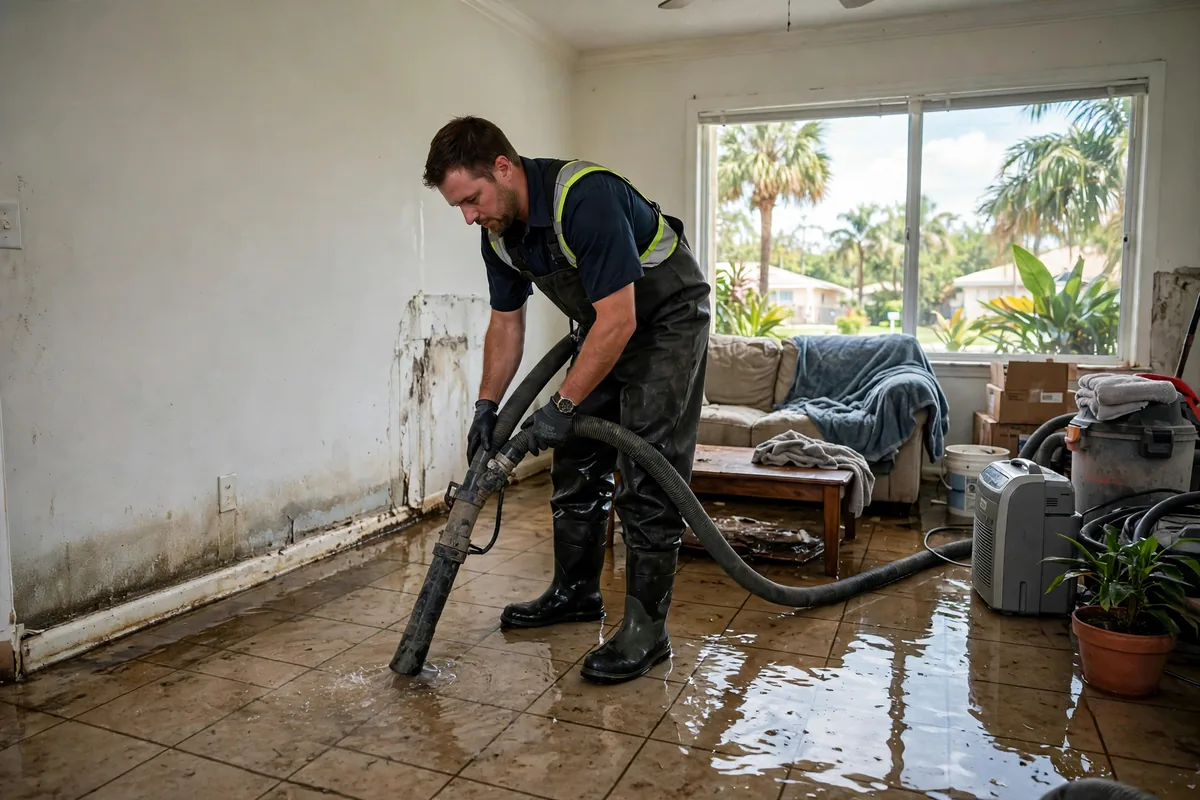
It starts with water extraction — removing standing water with powerful extraction equipment or, in deeper flooding, a pump. Then structural drying takes over: air mover fans push air across wet surfaces while a commercial dehumidifier wrings the humidity out, helped by the AC system running normally again.
Materials react differently. Drywall (gypsum wallboard) that stayed wet usually has to be cut out above the water line; the padding packed inside the wall loses its effect and is normally removed; carpet pad acts like a sponge and is typically replaced, while hardwood flooring may cup and sometimes recover if drying starts fast. Tile and grout over a slab-on-grade home (built directly on the concrete) can look dry on top while water spreads underneath it. Anything that cannot be saved is removed, and an antimicrobial treatment (a disinfecting application that discourages mold) is applied to cleaned surfaces.
Pros also sort the water itself into Category 1 (clean, from a supply line), Category 2 (gray water with some contamination, like a washer overflow) and Category 3 (black water — sewage or river flood water). Category 3 changes everything: more protective gear, more material removal, stricter cleaning.
What Should You Do In The First Hour — And What Should You Avoid?
Safe first steps: if you can reach it safely, shut off the main water shutoff (the valve where the water line enters your home) for a plumbing leak, and keep people and pets out of any room with sewage or river water. Move dry belongings upstairs or onto counters, and take photos and short videos of every wet room before anything is moved — that record is gold for insurance documentation.
Now the hazards to respect: never walk through standing water near outlets or appliances, never touch a breaker panel with wet hands, and treat any sagging ceiling as a collapse risk. What not to do yourself: do not tear out drywall or flooring before the pro documents it, do not run a household vacuum on standing water, and do not just aim fans at Category 3 water — that spreads contamination. When in doubt, call first; the call is free.
Which Parts Of North Fort Myers See The Most Water Trouble?
The river side and the older subdivisions carry most of the risk. In Waterway Estates and Moody River Estates, canal and river frontage puts homes close to the water table, and many houses date from the community's big building years — the median home here was built in 1986 (the U.S. Census Bureau, ACS 2024 5-year), the 10th oldest median of the 19 Florida cities we serve. Herons Glen, the golf and country club community at 2250 Herons Glen Blvd, and nearby Jacaranda and Magnolia Landing are newer, but even newer roofs and AC systems fail in a storm.
One unusual number shapes the response: 85.7% of homes here are owner-occupied — the 2nd highest share of the 19 Florida cities we serve (state value 67.6%) — so most callers are protecting their own home, not a rental. Seasonal residents should note that a leak in an empty house can run for weeks; a neighbor with a key and a shutoff plan is cheap insurance.
Related Services We Offer
Water Getting Worse Right Now?
Standing water, a burst pipe or sewage cannot wait. See what to do first — and call now.
Neighborhoods We Serve In North Fort Myers
Herons Glen
Herons Glen Golf & Country Club is located at 2250 Herons Glen Blvd, North Fort Myers, FL 33917 (GolfPass).
Jacaranda
A named neighborhood inside North Fort Myers, in ZIP 33917.
Magnolia Landing
A named neighborhood inside North Fort Myers, in ZIP 33917.
Moody River Estates
A named neighborhood inside North Fort Myers, in ZIP 33903.
Waterway Estates
A named neighborhood inside North Fort Myers, in ZIP 33903.
Neighborhoods we serve include:
- Herons Glen
- Jacaranda
- Magnolia Landing
- Moody River Estates
- Waterway Estates
Show All 5 Neighborhoods
- Herons Glen
- Jacaranda
- Magnolia Landing
- Moody River Estates
- Waterway Estates
What Happens When You Call
1. You Call — It’s Free
One free call, answered 24/7. Tell us where the water is and what happened. There is no charge for the call and no obligation to book anything.
2. We Connect You With An Independent Local Pro
We match your call with an independent local water damage professional who serves your area — a separate local business, not our own crew.
3. The Pro Calls You Back Or Visits To Check The Problem
The pro can typically arrive in 30–60 minutes to check the problem in person, measure the moisture and explain the next steps before any work begins.
Why North Fort Myers Homeowners Call This Free Referral Line
This site is a referral service, not a restoration company — one free call connects you with an independent local water damage pro who serves North Fort Myers and greater Lee County, and that pro does the inspection, the drying and the repairs under their own name.
That matters on the river side of Lee County, where a wet home can be a burst pipe, a roof problem or river water — three different jobs. The line is answered 24/7, the call costs nothing, and there is no obligation to hire the pro you are connected with. Ask them about their drying plan, how they document moisture readings, and what they will do about mold prevention before you sign anything.
What Homeowners Say
Reviews shown exactly as given to us (name, city, words) — we do not edit them.
“After suffering severe storm surge damage, this company came through when many other contractors weren't answering the phone. Hardworking, courteous crew.”
Gregory M. · Fort Myers, FL
“Great customer service and transparent pricing. The crew monitored moisture levels daily and explained the drying progression clearly until everything met safety standards.”
Carlos G. · Cape Coral, FL
“Our water heater ruptured while we were away for the weekend. The damage was extensive, but this team stepped in immediately, handled pack-out of our rugs, and completely dried the structure.”
Sarah T. · Naples, FL
ZIP Codes We Serve In North Fort Myers
North Fort Myers ZIP codes we serve: 33903, 33917. If your ZIP is not listed, call and we will confirm coverage.
North Fort Myers Water Damage Questions
Is North Fort Myers In A Flood Zone?
Parts of it are, especially near the Caloosahatchee. FEMA maps zones A, AE and VE in this area — VE is the highest-hazard coastal zone. Check your exact address free at the federal Map Service Center (msc.fema.gov) by typing in your street address; your zone decides whether flood insurance is required by your lender.
My Home Sits Near A Canal In Waterway Estates. What Should I Watch For?
Canal-side homes sit close to the water table, so watch for damp smells after king tides or long rain spells, bubbling paint at the base of river-side walls, and floors that feel soft near exterior doors. Small signs caught early are a drying job; ignored, they become a mold and flooring job.
Can River Flood Water Be Cleaned Up Like A Normal Leak?
No. River and storm water is Category 3 — the most contaminated class — because it can carry sewage, chemicals and bacteria. Cleanup means more protective equipment, removal of porous materials like carpet pad and wet drywall, and antimicrobial treatment. Keep children and pets out of the water until a pro has cleared the rooms.
We Are Snowbirds. How Do We Protect The House While We Are Away?
Shut off the main water shutoff before you leave, set the AC to keep running so humidity stays controlled, and have a neighbor check after big storms. Most away-from-home disasters here come from a water heater or supply line that leaks for weeks into an empty house.
Does Homeowners Insurance Cover Caloosahatchee Flooding?
Standard homeowners policies in Florida generally do not cover flood water that rises from outside — that is what a separate flood insurance policy is for. Sudden pipe leaks inside the home are a different claim type. Read your policy or ask your agent before storm season, not after.
How Fast Can Someone Get To My North Fort Myers Home?
One free call connects you with an independent local pro who serves this area, and that pro can typically arrive in 30–60 minutes. Times vary with weather and how many homes are affected after a storm, which is exactly why calling early — at the first sign of water — helps.
Related Guides
Is Your Well Water Safe After Flooding?
Guide — well water safety after flooding
Septic System Care After Flooding
Guide — septic system care after flooding
King Tides And Tidal Flooding In Florida
Guide — what are king tides
Reviewed By Hamza
Role: CEO
Hamza is the CEO of this business. He is very expert in local business and has great experience.
Updated October 23, 2026
Sources
Water In Your Home Right Now?
One free call connects you with an independent local pro who can typically arrive in 30–60 minutes.
📞 Call Now — It’s FreeFree Call · Answered 24/7 · Local Pros Near You