
Water Damage In Plant City, FL
Water damage in Plant City, FL tends to announce itself late — a stain spreading across a ceiling, a floor that feels spongy, a doubled water bill. This city averages 56.11 inches of rain a year, so plumbing leaks and storm water do real damage here. One free call connects you with an independent local pro who can typically arrive in 30–60 minutes.
Do I Have This Problem?
Tap every sign you see at home. This is a guide, not a diagnosis — only a pro can confirm the problem.
Plant City At A Glance
How Plant City Compares
Rankings are among the 19 Florida cities we serve. Sources: U.S. Census Bureau ACS 2024 5-year estimates; NOAA 1991–2020 Climate Normals. Method: each city is ranked 1 = highest (median year built: 1 = oldest) from data/cities.csv — see the sources list at the bottom of this page.
What Are The Warning Signs Of Water Damage In A Plant City Home?
Water damage usually whispers before it shouts: ceiling stains, a musty odor that stays in one room, baseboards pulling away from the wall. In Plant City's heat and humidity, mold growth can start in 24-48 hours on wet material — small signs deserve fast attention.
- Stains, bubbling paint, or a ceiling that feels soft when pressed
- A musty smell with no spill you can find — moisture is hiding somewhere
- Swollen baseboards, warped laminate, or tiles that sound hollow underfoot
- A water bill jump, or a meter that creeps when every tap is off
Your city water utility — the city service that treats your drinking water and mails the bill — reads the meter, but finding the leak is on you. Note the reading, use no water for an hour, then check again: movement means water is escaping somewhere.
What Usually Causes Water Damage In Plant City Homes?
Plant City homes are hurt more by their own plumbing than by weather: burst supply lines, slab leaks and failed appliances top the list, and the older core — median home built 1989, a third of homes predating 1980 — carries the most pipe risk.
A burst pipe often starts as corrosion inside a cast iron drain pipe — an iron drain line that rusts from within — or as a pinhole in a copper pipe under the floor. A slab leak, a line leaking under the concrete slab, can run silently until the floor warms or the bill spikes. Appliance failures are just as common: a split water heater, a washing machine hose, a dishwasher valve. And an AC condensate overflow — the air conditioner's drain line clogged with algae — spills water into ceilings and closets, sometimes for days, before anyone notices.
How Do Heavy Rain And The High Water Table Affect Plant City?
You do not need a coastline to flood. The city averages 56.11 inches of rain a year (NOAA 1991–2020 normals, Plant City station) — the 5th highest total of the 19 Florida cities we serve — and much of it lands in hard summer downpours.
When rain falls faster than ditches and ponds can drain, flash flooding can push water under doors and into garages. Between storms, groundwater keeps soil saturated, so moisture presses against foundations and seeps through slab cracks. A roof leak makes it worse, especially when wind-driven rain gets under shingles during a hurricane or tropical storm in the Atlantic hurricane season.
FEMA flood zones A, AE, AH and X are mapped in the city area; a FEMA flood zone AE parcel is high-risk land with a calculated base flood elevation. Check your address at msc.fema.gov — two minutes now beats a surprise later.
How Does A Pro Track Down Moisture You Cannot See?
A pro locates hidden water by measuring, not guessing: walls, floors and cabinet boxes are tested point by point, and the readings are drawn into a moisture map.
The everyday tool is a moisture meter, which reads dampness inside a material; a pinless moisture meter scans wider areas without leaving pinholes, which matters on finished walls and wood floors. A thermal imaging camera adds the picture — evaporating water cools a surface, so wet areas show as darker shapes that trace the leak's path back to its source.
Readings are repeated daily until each material reaches its dry standard — the moisture level that same material holds in a dry part of the house.
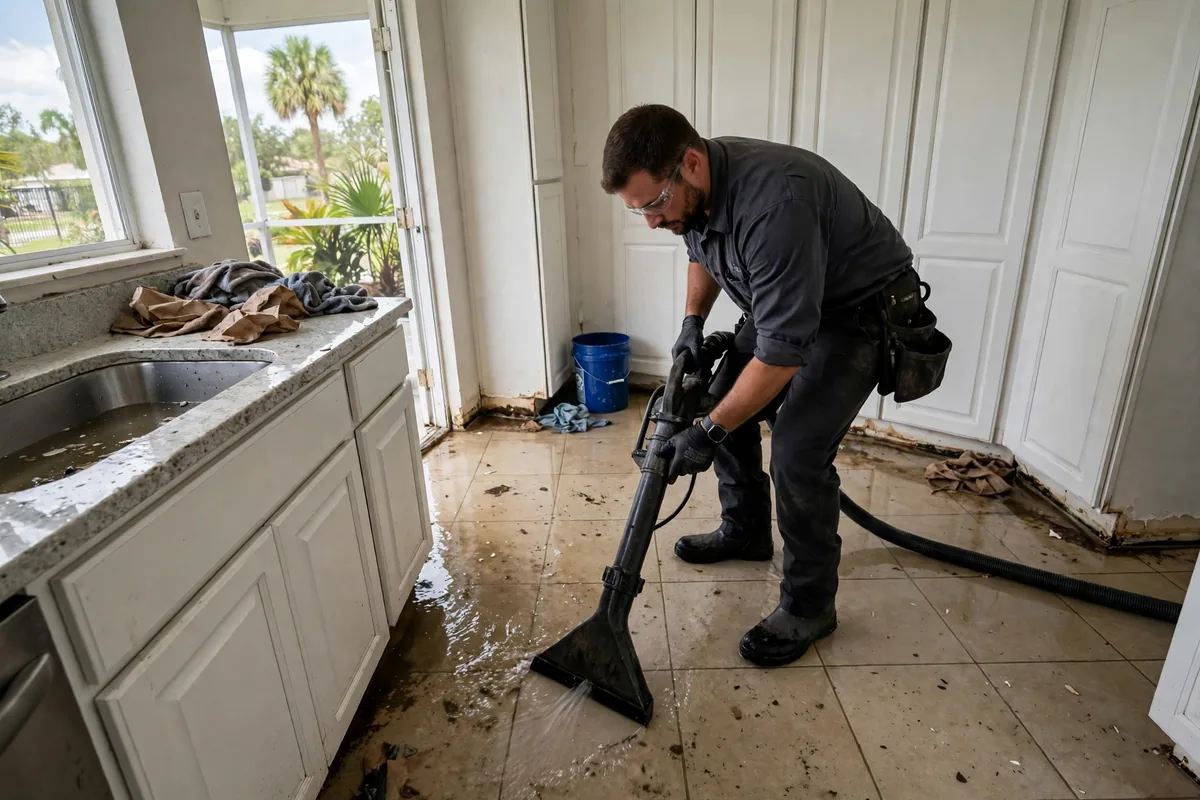
Drying starts with extraction — a pro removes standing water with pumps and truck-mounted extractors before any air mover is switched on, because surface water left in place keeps soaking deeper.
What Happens During Drying — And Why Water Categories Matter
Drying runs in a fixed order: standing water comes out first, then structural drying with air movers and dehumidifiers, then anything too wet to save is removed, and surfaces get an antimicrobial treatment. The water's category decides how cautious each step must be.
Pros sort water into three categories. Category 1 water is clean, from a supply line. Category 2 carries soil or chemicals — a washing machine overflow. Category 3, or black water, is heavily contaminated: a sewage backup or outside flood water lands here and demands protective gear and stricter disposal.
Materials decide what stays. Drywall drinks water upward and is usually cut above the wet line; soaked insulation traps damp against framing and rarely dries in place; carpet pad behaves like a sponge and is typically discarded. Hardwood flooring can sometimes be rescued with fast drying, while tile and grout can look dry on top as water creeps underneath across a slab-on-grade home. Air-drying with open windows rarely works here — the outdoor humidity is often as high as inside.
Your safe first steps: shut off the water at the main valve if it is safe to reach, stay out of rooms where water touches outlets, and photograph everything while you wait.
What Should You Do While You Wait — And What Should You Avoid?
Start by stopping the source: close the main water shutoff — the valve where the water line enters your home, or at the meter — and call for help. If one appliance is the problem, its own shutoff valve may do.
Then protect people. Keep everyone away from water that touches outlets, cords or the electrical panel; electricity and standing water are a lethal mix. Skip any room with a bulging, sagging ceiling, and treat sewage or yard flood water as contaminated — keep children and pets out entirely.
Two common instincts cause harm. Never run a household vacuum on standing water — the shock risk is real. And do not rip out drywall, trim or flooring in a rush: tearing materials out before photos are taken can spread contamination and weaken your insurance documentation. Move dry belongings to a dry room instead, and let the drying plan start from evidence.
Which Plant City Neighborhoods See The Most Water Damage?
Risk in Plant City follows housing age and ground more than any single street. Citywide, 33.0% of homes were built before 1980 and the median year built is 1989 (U.S. Census Bureau, ACS 2024) — a mix of an older core and newer subdivisions.
Walden Lake, the neighborhood most people here picture first, is an approximately 2,000-acre master-planned community in ZIP 33566, with homes from several decades around its lakes; low spots near the water and aging supply lines in its older sections are the usual starting points. Around Downtown Plant City and Lincoln Park, pre-1980 homes carry original cast iron drains and older roofs. Trapnell Ridge (ZIP 33567) and Pinecrest skew newer, where calls are more often appliance and AC drain failures than pipe age.
Ownership matters too: 66.4% of Plant City homes are owner-occupied, close to the Florida state value of 67.6% — most residents catch the bill jump or the smell themselves, which is why the meter test above is worth learning.
How Do You Document Water Damage For A Claim In Plant City?
Claims are decided on paperwork, so build the file before cleanup erases it: photograph every wet room, film the source if you can see it, and list damaged belongings.
Ask the pro drying your home for the supporting documents — the moisture map, daily monitoring logs and a written scope of what got wet and what was removed. Keep receipts for anything you buy or throw out. One caution: flood water from outside is usually handled under a separate National Flood Insurance Program (NFIP) policy — the federal flood insurance program — not a standard homeowners policy, so check which policy applies before assuming either way.
Related Services We Offer
Water Getting Worse Right Now?
Standing water, a burst pipe or sewage cannot wait. See what to do first — and call now.
Neighborhoods We Serve In Plant City
Walden Lake
The City of Plant City describes Walden Lake as an approximately 2,000-acre master-planned residential community located within the city.
Cherry Park
A named neighborhood inside Plant City, in ZIP 33563.
Collins Park
A named neighborhood inside Plant City, in ZIP 33563.
Downtown Plant City
A named neighborhood inside Plant City, in ZIP 33563.
Lincoln Park
A named neighborhood inside Plant City, in ZIP 33563.
Magnolia Green
A named neighborhood inside Plant City, in ZIP 33563.
Orange Heights
A named neighborhood inside Plant City, in ZIP 33563.
Pinecrest
A named neighborhood inside Plant City, in ZIP 33563.
Neighborhoods we serve include:
- Cherry Park
- Collins Park
- Downtown Plant City
- Lincoln Park
- Magnolia Green
- Orange Heights
- Pinecrest
- Plant City Heights
- Trapnell Ridge
- Walden Lake
- Whispering Woods
Show All 11 Neighborhoods
- Cherry Park
- Collins Park
- Downtown Plant City
- Lincoln Park
- Magnolia Green
- Orange Heights
- Pinecrest
- Plant City Heights
- Trapnell Ridge
- Walden Lake
- Whispering Woods
What Happens When You Call
1. You Call — It’s Free
One free call, answered 24/7. Tell us where the water is and what happened. There is no charge for the call and no obligation to book anything.
2. We Connect You With An Independent Local Pro
We match your call with an independent local water damage professional who serves your area — a separate local business, not our own crew.
3. The Pro Calls You Back Or Visits To Check The Problem
The pro can typically arrive in 30–60 minutes to check the problem in person, measure the moisture and explain the next steps before any work begins.
Why Plant City Homeowners Call This Free Referral Service
This site does not dry houses — it connects people. One free call puts you together with an independent local water damage pro, and the call costs nothing, with no obligation to book.
When water is spreading at midnight, that one call replaces a dozen searches and voicemails. The pro who responds can typically arrive in 30–60 minutes, and from there you work with them directly — their pricing, their schedule, their responsibility for the job.
What Homeowners Say
Reviews shown exactly as given to us (name, city, words) — we do not edit them.
“A severe thunderstorm damaged our roof and caused major water intrusion into our living room. The crew arrived in under an hour, extracted the standing water, and set up industrial dehumidifiers. Completely saved our hardwood floors.”
Brenda S. · Tampa, FL
“Water damage is every homeowner's worst fear in Florida. This crew arrived with high-end moisture sensors, extracted gallons of water, and kept our family safe from mold.”
Scott Z. · Brandon, FL
“Heavy rain exposed a hidden leak around our window casing. The technicians contained the area with plastic sheeting, dried the insulation, and kept the rest of the house dust-free.”
Thomas P. · Lakeland, FL
ZIP Codes We Serve In Plant City
Plant City ZIP codes we serve: 33563, 33565, 33566, 33567. If your ZIP is not listed, call and we will confirm coverage.
Plant City Water Damage Questions
Can Plant City Homes Flood Even Though The City Is Inland?
Yes. Plant City averages 56.11 inches of rain a year, and hard downpours can overwhelm ditches and retention ponds, pushing water under doors and into garages.
How Can I Tell If I Have A Slab Leak In Plant City?
Common clues are a warm spot on the floor, the sound of running water when nothing is on, a sudden bill jump, or a meter that keeps moving with every tap closed. A pro confirms it with moisture meters and thermal imaging, then maps where the water has traveled under the slab before opening the floor.
How Much Rain Does Plant City Get Each Year?
Plant City averages 56.11 inches of rain a year (NOAA 1991–2020 climate normals, Plant City station) — the 5th highest average of the 19 Florida cities we serve. Most arrives in summer thunderstorms and tropical systems, which is why roof leaks and yard flooding so often appear in the same week.
How Quickly Can Mold Grow After A Leak In A Plant City Home?
Mold growth can begin within 24 to 48 hours on wet drywall, insulation and carpet pad in Florida's warm, humid conditions. That short window is why same-day water extraction and structural drying matter here — a leak left over a long weekend can turn a straightforward drying job into a mold cleanup.
Are Newer Plant City Subdivisions Safe From Water Damage?
Safer from pipe age, not from water. Newer communities like the later sections of Walden Lake have modern plumbing, but still face appliance failures, AC condensate overflows, roof leaks in storms and low-lying lots near lakes and ponds. The causes change with the decade; the need for fast drying does not.
What Should I Do First If My Water Heater Starts Leaking?
Turn off the heater's water supply valve and its power or gas if you can reach them safely, then move stored items out of the spreading water and take photos. Make one free call to be connected with a local pro — a failed water heater can release its full tank plus a continuous feed, so minutes count.
Related Guides
Hurricane Season: Prepare Your Home For Water Damage
Guide — hurricane season water damage preparation
How To Prevent Water Damage In A Florida Home
Guide — how to prevent water damage
Groundwater Seeping Up Through Your Slab
Guide — groundwater seeping through slab
Reviewed By Hamza
Role: CEO
Hamza is the CEO of this business. He is very expert in local business and has great experience.
Updated October 23, 2026
Sources
Water In Your Home Right Now?
One free call connects you with an independent local pro who can typically arrive in 30–60 minutes.
📞 Call Now — It’s FreeFree Call · Answered 24/7 · Local Pros Near You