
Water Damage In Pinellas Park, FL
Water damage in Pinellas Park, FL rarely stays small: 56.7% of local homes were built before 1980, and hidden leaks spread fast under slab floors. One free call connects you with an independent local pro who can typically arrive in 30–60 minutes, 24/7.
Do I Have This Problem?
Tap every sign you see at home. This is a guide, not a diagnosis — only a pro can confirm the problem.
Pinellas Park At A Glance
How Pinellas Park Compares
Rankings are among the 19 Florida cities we serve. Sources: U.S. Census Bureau ACS 2024 5-year estimates; NOAA 1991–2020 Climate Normals. Method: each city is ranked 1 = highest (median year built: 1 = oldest) from data/cities.csv — see the sources list at the bottom of this page.
What Are The Signs Of Water Damage In A Pinellas Park Home?
The earliest signs are water stains on a ceiling or wall, a musty smell in one room, and swollen baseboards — often from a slow leak under the floor. Speed matters, because mold growth can start in 24-48 hours in Florida's warm, humid air.
Watch for these signs:
- Water stains, bubbling paint, and soft spots in ceilings or walls
- A musty smell with no visible water anywhere — often the first clue of a hidden leak
- Swollen baseboards, warped floors, and tiles that feel loose or hollow
- A sudden water bill jump, or a water meter running when nothing is using water
Your city water utility — the city service that supplies your tap water and sends your water bill — cannot find the leak for you, but a bill jump is often the first warning. Check the meter with everything off: if the reading moves within an hour, water is going somewhere a pro needs to find.
What Causes Water Damage In Pinellas Park Homes?
Most local water damage starts inside the house — burst pipes, appliance failures and AC drain problems cause far more call-outs than storms do. Older housing makes pipe failures the biggest risk here: the median home was built in 1978.
Burst pipes and pinhole leaks often come from aging cast iron drain pipe, which rusts from the inside in homes built before the mid-1970s. Slab leaks, in water lines under the concrete floor, are common in a slab-built city and can run for weeks before a stain shows. Appliance failures are the third big cause: a split water heater, a burst washing machine hose or a leaking dishwasher can release gallons unnoticed. An AC condensate overflow happens when the condensate drain line clogs with algae; the pan overflows into ceilings and closets, sometimes for days.
How Do Hurricanes, Flood Zones And The High Water Table Affect Pinellas Park?
Pinellas Park sits only about 13.7 feet above sea level at its Census survey point, so hurricane and flood water is a real risk even off the beach. Flood zones A, AE, AH and X are mapped in the city area. A FEMA flood zone AE area is a mapped high-risk flood area with a 1 percent annual chance of flooding and a calculated base flood elevation; in high-risk zones, flood insurance is usually required with a federally backed mortgage.
The bigger everyday threat is wind-driven rain: storm winds push rain through eaves, vents and window seals, so roof leaks often appear far from where the water got in. A king tide — an unusually high tide that can flood low streets even without rain — can back up drainage near the bayous, and the high water table pushes moisture up toward floors in the rainy season.
To check your own flood zone, open the FEMA Map Service Center at msc.fema.gov and enter your address — worth doing before storm season.
How Do Pros Find Hidden Water Damage?
Pros find hidden water with moisture meters and moisture mapping, not guesswork: they measure walls, floors and cabinets room by room and map exactly how far the water has spread.
A moisture meter reads how wet a material is below the surface, and a thermal imaging camera shows cool, damp areas as color patterns, tracing a leak's path without opening walls first. Drying only what you can see leaves wet material hidden — where mold starts.
Drying is checked with daily monitoring: repeat readings each day until every material reaches its dry standard — the moisture level of the same material in an unaffected part of the home.
How Do Drying And Cleanup Work — And What Do Water Categories Mean?
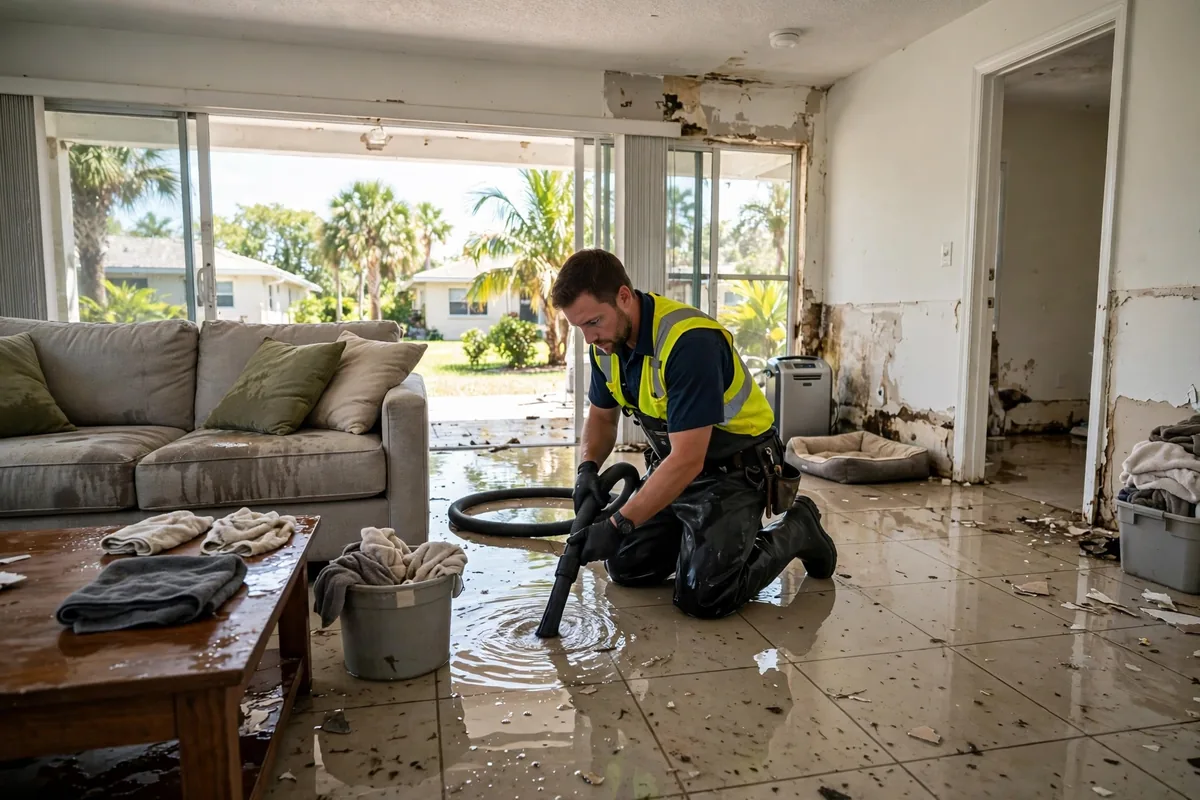
Cleanup follows a set order: water extraction first, then structural drying with air movers and dehumidifiers, then removing materials that cannot be saved, and antimicrobial treatment and sanitizing at the end. How far each step goes depends on the water category.
Pros sort water into three categories. Category 1 is clean water from a supply line. Category 2, or gray water, carries dirt or chemicals — a washing machine overflow, for example. Category 3, or black water, is heavily contaminated: sewage backup and flood water are always Category 3 and need stricter cleanup.
Materials react differently. Drywall wicks water upward and often has to be cut above the wet line; wet insulation holds moisture against framing and usually cannot dry in place. Carpet pad acts like a sponge and is usually removed even when the carpet can be saved. Hardwood flooring cups and warps but can sometimes be saved if drying starts fast. Tile and grout look dry on top while water travels underneath across the slab of a slab-on-grade home. And leaving a Florida home to dry on its own is unreliable — humidity is so high that natural drying stalls, so pros close the house up and run equipment.
What Should You Do First — And What Should You Never Do Yourself?
The safest first step is to stop the water: turn off the main water shutoff, usually at the meter or where the main line enters the home, then call for help. If the source is one appliance, its own valve may be enough.
Keep safety first. Never walk through standing water that may touch outlets, appliances or your electrical panel — electricity near water can kill. Stay out of any room with a sagging ceiling, which can collapse without warning, and treat sewage or flood water as contaminated.
Just as important is what NOT to do yourself. Never use a household vacuum on standing or contaminated water — it is an electric shock risk. Do not tear out drywall, baseboards or flooring before the damage is documented and a pro has checked what can be saved — tearing out materials too early can spread contamination and hurt an insurance claim.
Your safe first steps while you wait: if it is safe, shut off the water at the main water shutoff and turn off power to wet rooms at the breaker. Move dry belongings out of the wet area, take photos for your claim, and do not tear out materials or use a household vacuum on the water — those first steps keep you safe and keep the damage record clean while you wait for the pro.
Why Are Pinellas Park's Older Homes And Neighborhoods At Higher Risk?
Pinellas Park's housing is older than most of Florida's: 56.7% of homes were built before 1980, the median year built is 1978, and 69.0% of homes are owner-occupied, according to the U.S. Census Bureau. That age shows up in original plumbing and older roofing — common starting points for water damage.
The pattern holds across the city's neighborhoods. The Mainlands of Tamarac, a well-known 55+ community of about 1,500 homes in ZIP 33782, is made up largely of older single-story slab homes; water damage in Mainlands of Tamarac homes often starts with aging supply lines and AC drains. In Cross Bayou Park and Skyview Terrace (ZIP 33781), lower ground near the bayous means street flooding can reach garages in downpours. Sparkle Lake and Pine Haven have the same older slab-built stock, where a leak can travel under tile through several rooms.
How Should You Document Water Damage For An Insurance Claim?
Document everything before cleanup changes it: photos and short videos of every wet room, the water source if you can see it, and damaged belongings. Insurers decide claims on evidence, and the first hours are when it is clearest.
Ask the pro who dries your home for their paperwork — moisture logs from daily monitoring, the moisture map, and a written scope of what was wet and removed. Keep receipts, and keep damaged materials until your insurer says otherwise.
Related Services We Offer
Water Getting Worse Right Now?
Standing water, a burst pipe or sewage cannot wait. See what to do first — and call now.
Neighborhoods We Serve In Pinellas Park
Mainlands of Tamarac
55+ community of about 1,500 single-family condo homes spread across seven distinct neighborhoods
Adlo
A named neighborhood inside Pinellas Park, in ZIP 33781.
Allamanda Park
A named neighborhood inside Pinellas Park, in ZIP 33781.
Angela Heights
A named neighborhood inside Pinellas Park, in ZIP 33781.
Angelas Gardens
A named neighborhood inside Pinellas Park, in ZIP 33781.
Autumn Run
A named neighborhood inside Pinellas Park, in ZIP 33781.
Avondale Estates
A named neighborhood inside Pinellas Park, in ZIP 33781.
Barclay Woods
A named neighborhood inside Pinellas Park, in ZIP 33781.
Neighborhoods we serve include:
- Adlo
- Allamanda Park
- Angela Heights
- Angelas Gardens
- Autumn Run
- Avondale Estates
- Barclay Woods
- Bayou Pointe
- Bayou West
- Beacon Run
- Boulevard Park
- Country Haven
- Cross Bayou Park
- Debra Heights
- Derby Landings
- El Doro
- Eleanor Manor
- Fairlawn Park Manor
- Florida Retirement Village
- Fortuna Park
- Foxmoor Estates
- Garnett
- Grand Arcade
- Greendale Estates
Show All 65 Neighborhoods
- Adlo
- Allamanda Park
- Angela Heights
- Angelas Gardens
- Autumn Run
- Avondale Estates
- Barclay Woods
- Bayou Pointe
- Bayou West
- Beacon Run
- Boulevard Park
- Country Haven
- Cross Bayou Park
- Debra Heights
- Derby Landings
- El Doro
- Eleanor Manor
- Fairlawn Park Manor
- Florida Retirement Village
- Fortuna Park
- Foxmoor Estates
- Garnett
- Grand Arcade
- Greendale Estates
- Harmony Heights
- Heritage Reserve
- Hoffman Heights
- Holiday Haven Homes
- Homeland
- Indiana Heights
- Interurban Park
- Jan Cory
- Juanita Park
- Lake Donald
- Lake Forest
- Larsons Manor
- Lynn Haven
- Mainlands of Tamarac
- Malinda Ann Estates
- Michigan Heights
- Monticello Gardens
- North Disston Park
- North Park Estates
- North Park Ridge
- Northfield Manor
- Oak Bluff
- Oak Bluff North
- Oak Park
- Orchid Lake
- Paradise Park
- Paradise Park Manor
- Park Plaza
- Park South
- Parkfield Estates
- Pine Acres
- Pine Haven
- Pinellas Park Manor
- Pinellas Pines Estates
- Ranch Lake Estates
- Sawgrass Village
- Scarsville
- Schofields
- Skyview Terrace
- Sparkle Lake
- Springwood
What Happens When You Call
1. You Call — It’s Free
One free call, answered 24/7. Tell us where the water is and what happened. There is no charge for the call and no obligation to book anything.
2. We Connect You With An Independent Local Pro
We match your call with an independent local water damage professional who serves your area — a separate local business, not our own crew.
3. The Pro Calls You Back Or Visits To Check The Problem
The pro can typically arrive in 30–60 minutes to check the problem in person, measure the moisture and explain the next steps before any work begins.
Why Pinellas Park Homeowners Use This Free Referral Service
We are a free referral service, not a contractor — one free call connects you with an independent local water damage pro who does the work. There is no charge for the call and no obligation to hire anyone.
That matters most at 2 a.m. with water spreading: one call, one explanation, and you are connected with a local pro who can typically arrive in 30–60 minutes, 24/7. From there you deal directly with the pro — they set their own prices and stand behind their own work.
What Homeowners Say
Reviews shown exactly as given to us (name, city, words) — we do not edit them.
“Hurricane rains pushed water through our patio sliding doors into two bedrooms. The team worked late into the night extracting water and setting up blowers. Their quick action prevented major mold damage.”
Patricia M. · St. Petersburg, FL
“The mitigation and drying equipment ran loudly for three days, but it did the trick. Moisture readings went from red to normal quickly. Very grateful for their hard work.”
Robert D. · Clearwater, FL
“The mitigation was done right and the house dried out safely, but communication between the field technicians and the central office was a bit disjointed.”
Mark S. · Largo, FL
ZIP Codes We Serve In Pinellas Park
Pinellas Park ZIP codes we serve: 33781, 33782. If your ZIP is not listed, call and we will confirm coverage.
Pinellas Park Water Damage Questions
How Do I Check My FEMA Flood Zone In Pinellas Park?
Enter your address at msc.fema.gov to see your zone. Pinellas Park has zones A, AE, AH and X mapped locally; A, AE and AH are high-risk, where flood insurance is usually required with a federally backed mortgage.
Why Do So Many Pinellas Park Homes Have Pipe Problems?
The median Pinellas Park home was built in 1978 and 56.7% of homes predate 1980, so many still have aging cast iron drain lines that rust from the inside and original slab plumbing — the most common sources of hidden leaks here.
How Fast Can Mold Start After A Leak In Florida?
Mold growth can start in 24-48 hours on wet drywall, carpet pad and wood in Florida's warm, humid air. That is why same-day extraction and drying matter — waiting a weekend can turn a drying job into a mold job.
How Much Rain Does Pinellas Park Get Each Year?
About 53.62 inches a year, based on NOAA's 1991–2020 climate normals for the St. Petersburg Intl AP station. Most falls in summer downpours and tropical systems, so roof leaks and street flooding often show up together.
Does Water Really Spread Under Tile Floors In Slab Homes?
Yes. Most Pinellas Park homes are slab-on-grade, so water runs across the concrete under tile and grout and can surface rooms away from the source. The tile can feel dry while the slab underneath is wet — which is why pros map moisture.
What Should I Do First When I Find Water Damage?
Stop the water at the main water shutoff if you can do it safely, keep people and pets out of the wet area, and avoid outlets and sagging ceilings. Then take photos and make one free call to be connected with a local pro.
Related Guides
Renters And Water Damage: Who Pays For What
Guide — does renters insurance cover water damage
How To Prevent Water Damage In A Florida Home
Guide — how to prevent water damage
How Long Does Water Damage Restoration Take?
Guide — how long does water damage restoration take
Reviewed By Hamza
Role: CEO
Hamza is the CEO of this business. He is very expert in local business and has great experience.
Updated October 23, 2026
Sources
Water In Your Home Right Now?
One free call connects you with an independent local pro who can typically arrive in 30–60 minutes.
📞 Call Now — It’s FreeFree Call · Answered 24/7 · Local Pros Near You