How Long Does Water Damage Restoration Take?
Reviewed By Hamza · CEO · Updated October 23, 2026
How long does water damage restoration take? For most clean-water jobs in a Florida home, the drying phase typically takes about 3 to 5 days, while the repairs that follow can take days to weeks depending on how much material was damaged. The honest answer is a range, not a date: the water source, how long it sat before drying started, and what it soaked all move the timeline. This guide breaks the job into its phases, explains what makes drying faster or slower, and shows how pros decide a home is actually dry — because that decision is made by measurement, not by the calendar.
The Three Phases, And What Each One Takes
A restoration job runs in three phases: emergency extraction, which usually happens the day the pro arrives; structural drying, which typically takes 3 to 5 days for clean water; and repairs, which vary the most. Understanding the phases explains why a pro can give you a firm drying estimate but only a rough repair window.
Phase 1 — stop the water and remove it (hours). The source is fixed or shut off, and standing water is extracted. A truck-mounted extractor, a powerful vacuum unit in the pro's truck, removes water from floors and carpet; for deeper standing water, a submersible pump, a pump that sits in the water and pushes it out through a hose, does the heavy lifting.
Phase 2 — drying (days). Equipment dries the structure, checked daily, until readings reach their targets.
Phase 3 — repairs (days to weeks). Damaged drywall, flooring or cabinets are rebuilt. Scheduling, materials and insurance approvals stretch this phase the most.
What The Drying Equipment Is Doing All Day
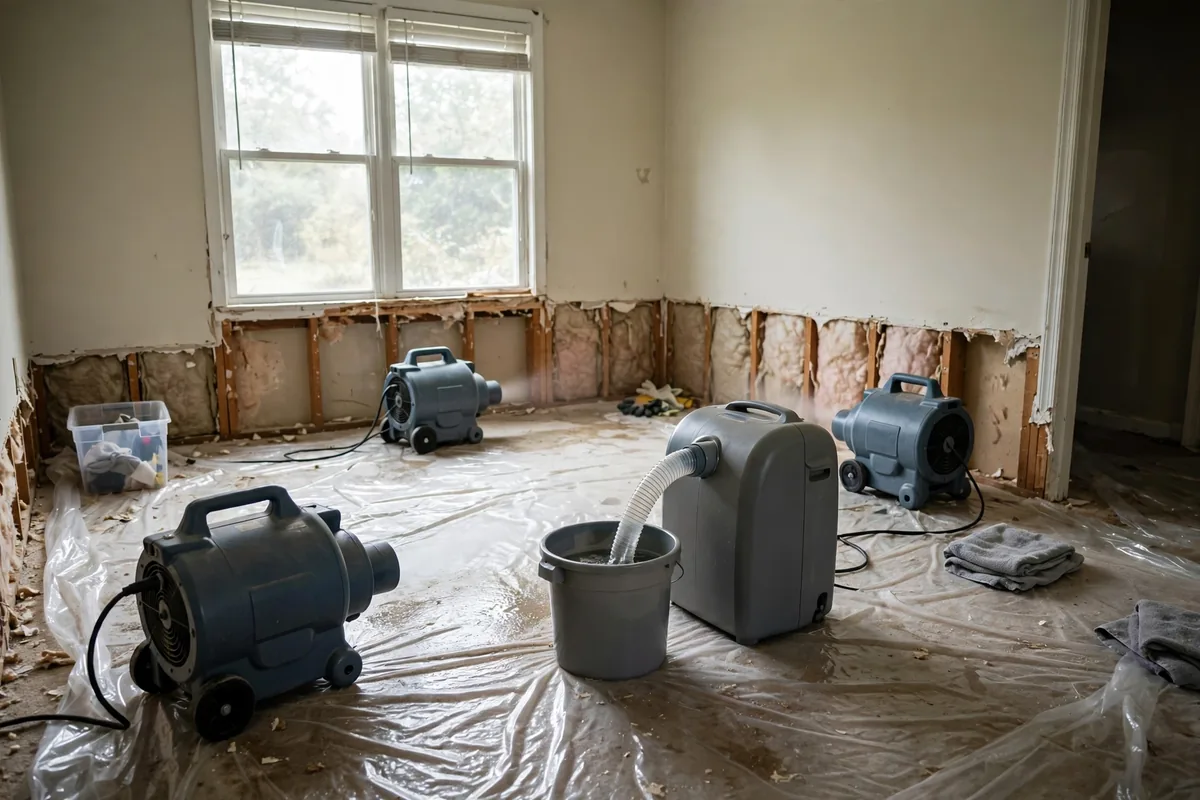
During the drying phase, an air mover — a high-speed fan that drives air across wet surfaces so moisture evaporates — works together with dehumidifiers that pull that moisture out of the air. Structural drying is the name for the whole controlled process: evaporate water from materials, remove it from the air, and verify the result daily.
An LGR dehumidifier, a low-grain refrigerant unit, is the workhorse in most homes because it keeps pulling moisture even as the air gets drier. In very wet or air-conditioned spaces a desiccant dehumidifier, which uses a moisture-absorbing material instead of refrigeration, may work better. The pro is practicing psychrometry, the science of how air, heat and moisture interact, whether or not they use the word: they measure temperature and humidity with a hygrometer, an instrument that measures moisture in the air, and adjust the setup each visit. Equipment placement changes as materials dry — the setup on day three rarely looks like day one.
Expect a short monitoring visit on most days of the drying phase. The pro takes fresh readings at the same marked points, empties or checks the dehumidifiers, and moves or removes equipment as areas reach their targets. Those visits are part of the timeline, not a delay in it — they are how the pro knows whether the job is on track for the original estimate or whether a hidden pocket of moisture is going to add a day.
What Makes Drying Take Longer
Drying takes longer when water has reached dense or hidden materials — hardwood, insulation inside walls, or a saturated subfloor — and when the water was dirty or sat for days before drying began. Clean water caught within hours is the fastest case; every complication adds days.
- Hardwood flooring dries slowly because moisture leaves through the board surfaces; a floor drying mat system, mats sealed to the floor that pull air through the boards, can save a floor that surface fans cannot.
- Wet insulation inside a wall cavity, the hollow space in a framed wall, holds water like a sponge and often has to be removed rather than dried.
- Carpet pad, the foam layer under carpet, usually cannot be dried in place and is removed so the subfloor can dry.
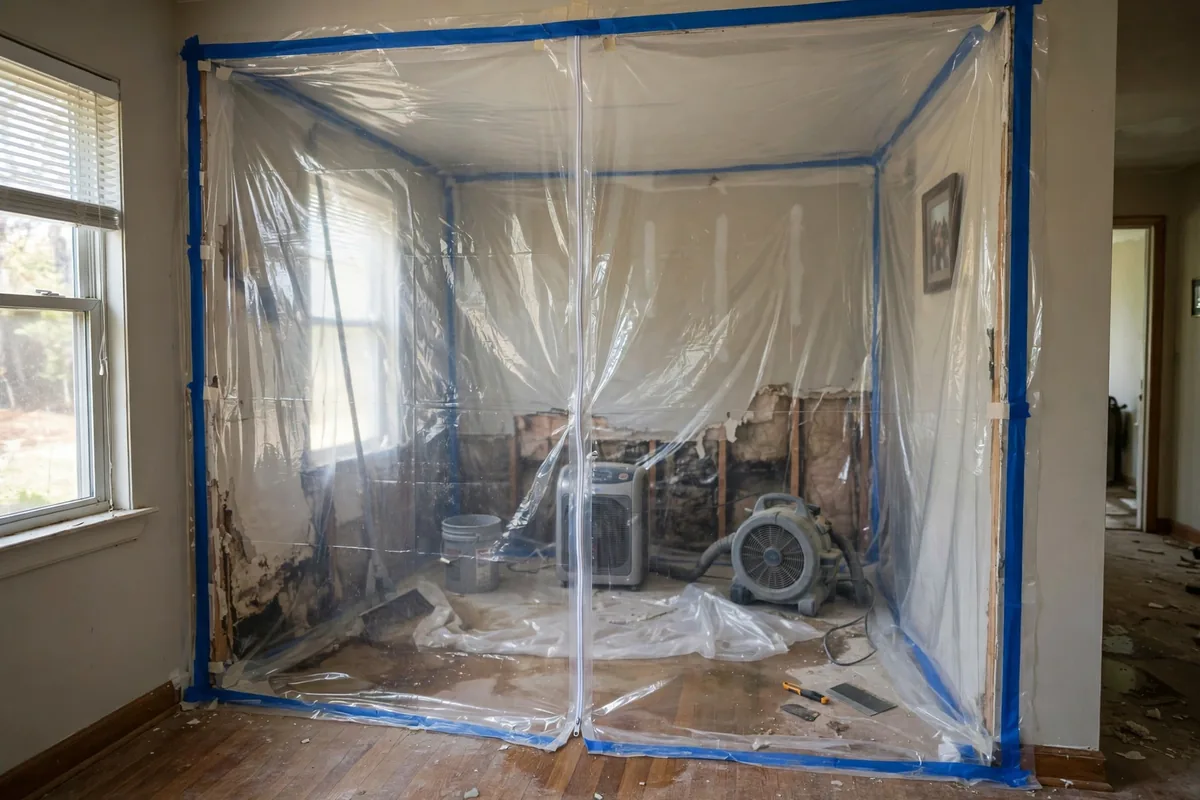
- Contaminated water or mold growth adds cleaning and containment steps before and during drying.
- Florida humidity works against the equipment whenever outside air leaks in, which is why pros seal the drying area.
How Pros Know When It Is Dry
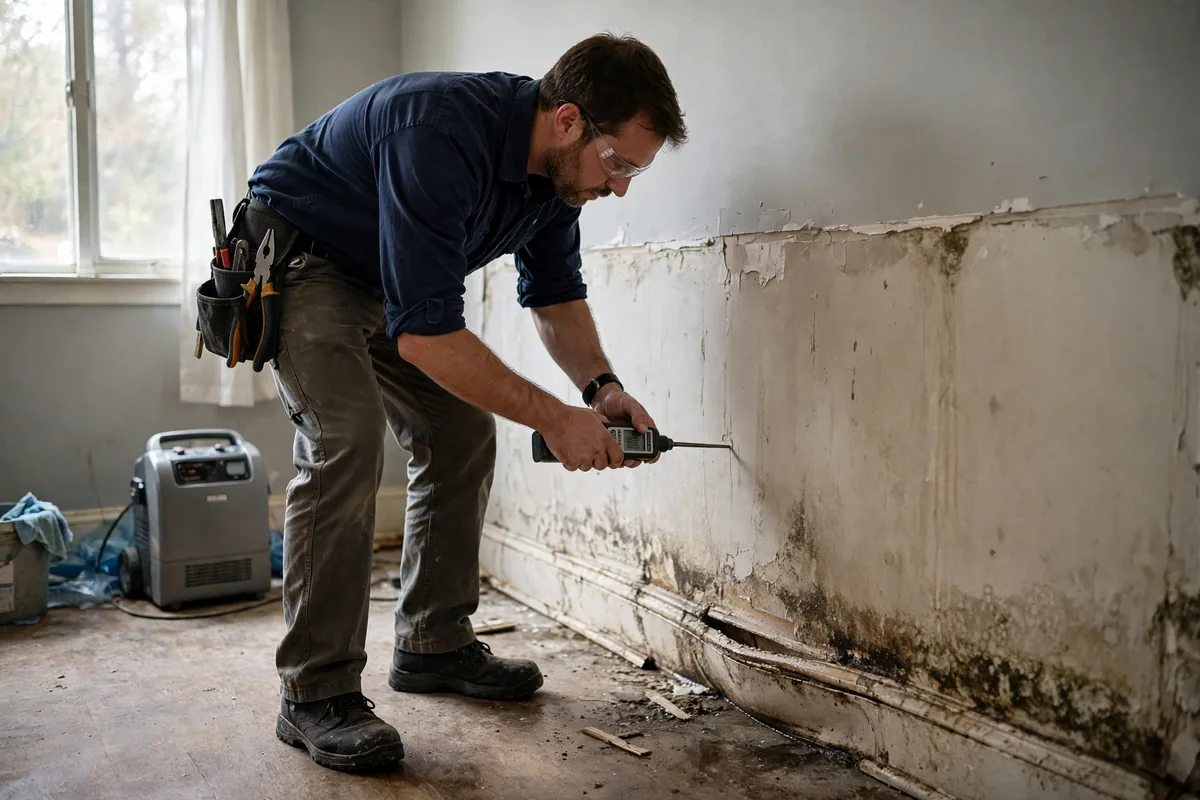
A pro knows drying is done when moisture meter readings in the affected materials match the readings of the same materials in an unaffected part of the home — the dry standard. A moisture meter is a handheld tool that measures how much water is inside wood, drywall and other materials, and the pro compares wet-area readings against that dry benchmark at every visit.
Moisture mapping, charting those readings on a sketch of the rooms, tracks the drying curve: readings should fall every day, and a reading that stalls tells the pro something is still feeding moisture — a hidden pocket in a wall cavity, or water under a floor. Drying is not finished because a surface feels dry to the touch. Drywall can feel dry on its face while its core and the material behind it are still wet. The final readings, not the number of days, are what close the drying phase.
Why Repairs Are A Separate, Longer Timeline
Repairs take longer than drying because they are construction, not drying: damaged walls have to be patched or rebuilt, flooring reinstalled, and cabinetry rebuilt or refitted, each on its own schedule. Materials have to be ordered, and if insurance is paying, the documented scope usually has to be approved before rebuilding starts.
The documentation from the drying phase — photos, moisture logs and the final dry readings — is what supports that approval, and it is one reason pros record everything as they go. Where mold was treated, an antimicrobial treatment, a product applied to cleaned surfaces to slow regrowth, happens before walls are closed back up. Because drying and repair crews, materials and approvals all run on separate clocks, the repair estimate is better treated as a window that narrows once the scope is approved. Ask the pro to separate the two timelines in writing: when drying ends, and what the repair sequence looks like after that. It keeps expectations honest on both sides.
Can You Stay In The Home During Restoration?
For most partial-home jobs you can stay in the home during restoration — the equipment is noisy and it runs day and night, but bedrooms and bathrooms outside the work area usually stay usable. Jobs involving sewage, heavy mold, or a whole-home flood are different, and the pro may recommend staying elsewhere until cleaning is done.
Two things help either way. Keep doors to the drying area closed so the equipment works on a smaller, controlled space, and do not turn machines off at night — stopping airflow lets humidity climb back into materials and can add a day or more to the job. The standards the industry works to, published by the IICRC, the Institute of Inspection, Cleaning and Restoration Certification, assume continuous drying with daily monitoring. If the noise is a problem, ask the pro about equipment placement — do not just unplug things.
Common Questions
Household fans dry exposed surfaces a little, but they cannot pull moisture out of a wall cavity, insulation or a subfloor, and they give no readings to prove dryness. In Florida, opening windows usually makes it worse by letting humid air in. Let the pro's equipment and daily checks set the pace — that is what the timeline is based on.
Because drying is continuous evaporation. When airflow and dehumidification stop, the air inside the room reaches balance with the wet materials and drying stalls — and humidity migrates back into surfaces that had started to dry. Running overnight is not wasted electricity; it is how the 3-to-5-day range is achieved at all. Your pro should be able to explain, in plain language, which readings are still high, what they mean for the next visit, and what would make the range shorter or longer.
Mold can start growing on wet materials within 24 to 48 hours in warm, humid conditions, according to U.S. Environmental Protection Agency guidance. That is why the timeline starts at the leak, not at the pro's arrival — water that sat for two days before drying began has already used up the safe window.
The drying phase usually is not — pros start drying right away to limit damage. The repair phase often is longer with insurance, because the scope and payment have to be documented and approved. Good moisture logs and photos from the drying phase are what keep that approval moving.