
Water Damage In Florida
Water damage in Florida rarely waits — if water is spreading through your home right now, one free call connects you with an independent local water damage pro who can typically arrive in 30–60 minutes. Tell us your city and what happened, and we will connect you with a local pro who serves your area.
Do I Have This Problem?
Tap every sign you see at home. This is a guide, not a diagnosis — only a pro can confirm the problem.
What This Free Referral Service Does
This site is a free referral service: one free call connects you with an independent local water damage pro near you. We are not the contractor, we do not repair homes ourselves, and the pro who responds is an independent business, not our employee.
Here is how it works:
- You call, at any hour, and describe what is happening in your home.
- We connect you with an independent local pro who serves your city.
- That pro can typically arrive in 30–60 minutes, find where the water is coming from, and explain what needs to happen next.
- You decide, with no obligation, whether to hire that pro to do the work.
Speed matters because water keeps moving while you wait. A burst pipe — when a pressurized water pipe splits or fails and releases a large amount of water in a short time — can soak walls and floors in minutes, and even a slow hidden leak spreads a little further every hour it runs. Calling early gives the pro a smaller, simpler problem to solve.
Signs Of Water Damage To Watch For
The most common early signs are water stains or bubbling, peeling paint, a musty smell in one room, swollen baseboards or warped floors, and a water bill that jumps for no clear reason. Any one of these can point to water damage hiding inside your home, and only a pro can confirm the problem in person.
Watch for these signs:
- Stains, bubbling or peeling paint on walls or ceilings.
- A musty smell in one room, with no visible water.
- Swollen baseboards, or floors that feel warped, cupped or soft.
- A water bill that jumped, or a water meter that keeps running with everything turned off.
- Standing water, or damage that is visibly getting worse right now.
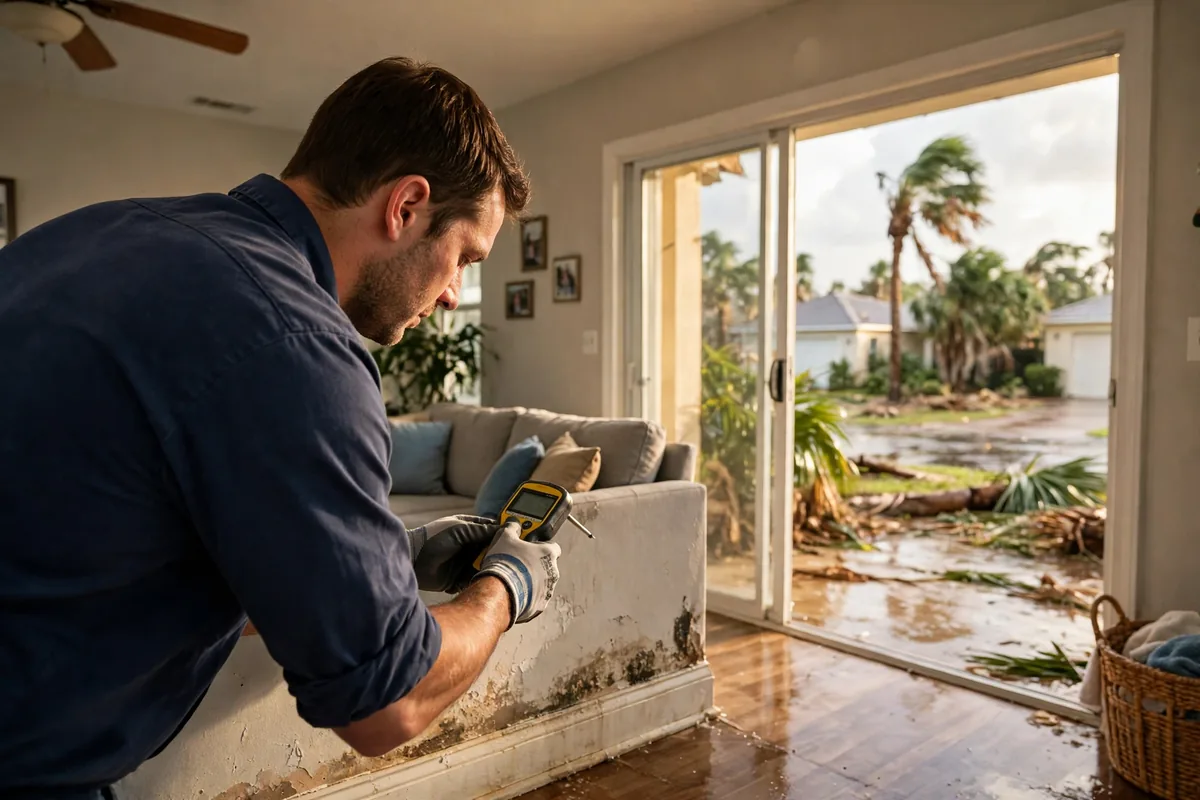
Hidden water is the tricky part. Drywall — the gypsum wall board used for interior walls and ceilings — soaks up water, swells, and can stay wet inside the wall long after the surface feels dry. Pros check with a moisture meter, a handheld tool that measures how much water is inside wood, walls and other materials, and a thermal imaging camera, a camera that shows temperature differences on a screen so cooler wet areas stand out. Finding the full wet area early is what keeps a small leak from becoming a much bigger repair.
Why Florida Homes Face Higher Water Risk
Florida homes face higher water risk than most of the country because heavy rain, coastal storms and older plumbing all meet here: across the 19 cities we serve, homes built before 1980 average 38.3% of the housing stock, average annual rainfall is about 55.5 inches, and all 19 cities have mapped flood hazard areas. Older homes, lots of rain and low, wet ground are a hard combination.
The Atlantic hurricane season — the June 1 to November 30 period each year when tropical storms can affect Florida — brings the biggest events. A hurricane is a tropical storm with sustained winds of 74 mph or more, and its storm surge — sea water pushed inland by the storm — floods coastal streets and homes and is treated as contaminated water. The National Hurricane Center, the national center that tracks tropical storms and issues storm surge forecasts, and the Florida Division of Emergency Management, the state agency for storm preparation and disaster recovery information, both publish guidance before and after these storms.
Plenty of damage has nothing to do with storms, though. Most Florida houses are a slab-on-grade home — built directly on a concrete slab, the thick concrete floor foundation the home sits on — with no crawlspace underneath. Water spreads sideways across that slab, under tile and along the foundation, the base the home is built on, and wicks up into walls. A roof leak, where water enters through damaged or aging roofing and shows up as a ceiling stain far from the entry point, and an AC condensate overflow, when the air conditioner drain line clogs and its pan overflows into ceilings and walls, are two of the most common non-storm causes we hear about.
Mold Prevention And Remediation After Water Damage
Preventing mold after water damage comes down to one thing: get the water out and the materials dry, fast. Mold growth — colonies of mold that grow on wet building materials — can start within 24 to 48 hours of wetting in warm, humid conditions, so the first two days matter most.
The U.S. EPA, the Environmental Protection Agency, which publishes guidance on mold and moisture control, makes the same point: fix the water problem and dry everything, because controlling moisture is the key to controlling mold. A pro's drying visit usually includes:
- Moisture mapping — measuring and recording exactly which walls, floors and materials are wet, so the drying plan covers the whole wet area.
- Placing an air mover — a powerful fan that pushes air across wet floors and walls so water evaporates faster — together with dehumidifying equipment.
- Structural drying — the planned drying of the building's materials with air movement and dehumidification, checked with daily readings until targets are met.
- An antimicrobial treatment — a cleaning product applied to surfaces to slow the growth of mold and bacteria after water damage.
If mold is already growing when the pro arrives, the work changes: the affected area may need to be sealed off while moldy material is removed, and porous materials that cannot be fully cleaned are usually taken out rather than dried in place. That is remediation — removing the growth and fixing the moisture source — and it starts with the same fast drying that prevents mold in the first place.
Reconstruction And Rebuild After Drying
Drying and rebuilding are two different phases: drying (often called mitigation) stops the damage and removes the water, and reconstruction is the rebuild that puts walls, floors and finishes back afterwards. One pro or company may handle both phases, or the rebuild may be done separately — ask whoever responds how they handle it.
Rebuild work commonly includes replacing drywall that was cut out, repairing or replacing flooring, refitting cabinets, and repainting. The IICRC, the Institute of Inspection, Cleaning and Restoration Certification, the industry body whose standard describes professional water damage restoration practice, is the reference many pros follow for both the drying and the repair side of a job.
What needs rebuilding depends on the source. A slab leak — a leak in a water pipe running under the home's concrete floor, which can spread water under flooring for weeks before it is noticed — may mean opening the floor to reach the pipe, often a copper pipe, a metal pipe used for water supply lines that can corrode and develop pinhole leaks over time. An appliance leak, water released by a failed household appliance such as a washing machine hose or dishwasher, usually damages one room's floor and cabinets. A water heater, the tank appliance that heats household water, can release its full contents at once when the tank fails. And a sewage backup, when a sewer or drain line reverses and pushes waste water into the home, is contaminated water: soaked porous materials are removed, not saved, which makes the rebuild bigger.
What Moves The Cost Up Or Down
No honest price can be given before a pro inspects your home, because the cost moves with the details of the job: how much water, what kind of water, how far it spread, and how long it sat. Any price quoted sight unseen is a guess, and we do not publish prices for work we do not do.
The factors that move the cost most:
- How much of the home is wet — one corner of one room, or several rooms.
- The kind of water — clean supply-line water is simpler to clean up than storm water or sewage.
- Which materials are affected — tile over concrete dries differently from wood floors, cabinets and wall insulation.
- How long the water sat before drying started — waiting lets water spread and lets mold start, which adds removal work.
- Access — water hidden under floors or inside walls takes more work to reach and dry.
- How much has to be rebuilt afterwards — drying alone, or drying plus new walls, floors and finishes.
This is why two homes on the same street can get very different quotes after the same storm, and why acting in the first 24 hours usually keeps the total lower: less spread, less mold, and fewer materials that have to come out.
What Homeowners Insurance Usually Covers And Excludes
A standard homeowners policy usually covers sudden, accidental water damage — like a pipe that bursts without warning — and usually excludes flooding from outside the home and slow leaks that went on for a long time. The exact answer always depends on your own policy, so treat this as a general guide, not a promise about your claim.
Usually covered, in general terms: damage from a sudden pipe failure, a failed appliance supply line, or rain that gets in because a storm damaged the roof. Usually excluded: rising water that enters from outside at ground level, gradual leaks and poor maintenance, and mold that grew because a leak was left sitting.
Flood damage is the big Florida exception. Standard homeowners policies do not cover it, which is why FEMA — the Federal Emergency Management Agency, which runs the national flood insurance program and publishes flood maps — offers cover through the National Flood Insurance Program (NFIP), FEMA's flood insurance program that offers flood policies through insurers. If your home took rising water, ask your insurer and check your flood map status rather than assuming either policy applies. Whatever happened, take photos and video before cleanup starts, keep receipts, and do not throw damaged items away until your insurer says to — that record is what a claim is built on.
Why Florida Homeowners Use This Service
Homeowners use this service because one free call, at any hour, connects them with an independent local pro instead of spending a stressful morning calling company after company. Water problems do not keep office hours, and neither does this phone line.
- The call is free, and it is the only step — one call connects you with a local pro.
- Help is available 24/7, including nights, weekends and storm days.
- The pro who responds can typically arrive in 30–60 minutes.
- The pro is independent and local to your area — we connect you, they do the work.
- You stay in control: the pro inspects, explains the options, and you decide whether to hire them.
- We are open about what we are: a referral service, not the contractor, with no claim that we do the work ourselves.
If you are standing in water, or watching a stain grow across your ceiling, the useful next step is the same either way: make the one free call and get a local pro on the way.
Related Services We Offer
One free call can connect you with a local pro for any of these water damage services.
What Happens When You Call
1. You Call — It’s Free
One free call, answered 24/7. Tell us where the water is and what happened. There is no charge for the call and no obligation to book anything.
2. We Connect You With An Independent Local Pro
We match your call with an independent local water damage professional who serves your area — a separate local business, not our own crew.
3. The Pro Calls You Back Or Visits To Check The Problem
The pro can typically arrive in 30–60 minutes to check the problem in person, measure the moisture and explain the next steps before any work begins.
Before And After Water Damage
Illustrations of a common problem and the fixed result — not photos of real jobs.
Water Getting Worse Right Now?
Standing water, a burst pipe or sewage cannot wait. See what to do first — and call now.
Water Damage Help Across Florida
We connect callers in 19 Florida cities. See the full list on the locations page.
Local Factors That Raise The Risk
Real numbers from the 19 Florida cities we serve (U.S. Census Bureau ACS 2024; NOAA 1991–2020 normals).
FEMA flood-hazard data for every city we serve (data/cities.csv)
ACS 2024 5-year, average across the 19 cities we serve; Florida state value 34.0%
NOAA 1991–2020 Climate Normals, nearest station per city
What Florida Homeowners Say
Reviews supplied for this site, shown exactly as given (name, city and words). We do not edit them.
“A severe thunderstorm damaged our roof and caused major water intrusion into our living room. The crew arrived in under an hour, extracted the standing water, and set up industrial dehumidifiers. Completely saved our hardwood floors.”
Brenda S. · Tampa, FL
“Hurricane rains pushed water through our patio sliding doors into two bedrooms. The team worked late into the night extracting water and setting up blowers. Their quick action prevented major mold damage.”
Patricia M. · St. Petersburg, FL
“Dishwasher supply line snapped and flooded our newly renovated kitchen. The technicians were meticulous about drying behind the custom cabinetry without having to tear it all out. Impressive work.”
Linda H. · West Palm Beach, FL
“After suffering severe storm surge damage, this company came through when many other contractors weren't answering the phone. Hardworking, courteous crew.”
Gregory M. · Fort Myers, FL
“Very professional operation. They worked directly with my homeowner insurance adjuster, providing moisture logs and thermal photos that sped up payment.”
Timothy G. · Palm Bay, FL
“They helped us through a severe roof leak after heavy windstorms. Cleaned, dried, and treated the entire attic space quickly.”
Angela Q. · Wesley Chapel, FL
Water Damage Questions
Does Homeowners Insurance Cover Water Damage In Florida?
Usually, yes for sudden and accidental damage — for example a pipe that bursts without warning — and usually no for flooding from outside or for slow leaks that were left for a long time. Every policy is different, so check yours, take photos before cleanup, and ask a local pro to document the source of the water, because the source is what the claim turns on.
Does Homeowners Insurance Cover Flooding From A Storm?
Standard homeowners policies do not cover rising water that enters your home from outside at ground level — that is flood damage, and it needs a separate flood policy. If your home took storm water, call your insurer promptly anyway, tell them exactly what happened, and keep damaged items until they say otherwise.
What Should I Do Right After Water Damage?
Stay safe first: keep people and pets out of any water that may have touched electricity or sewage. If it is safe, shut off the water at the main valve and take photos and video of everything before you move it. Then make one free call — a local pro can typically arrive in 30–60 minutes to start removing water and drying, which is what limits the damage.
Does Insurance Cover Mold From Water Damage?
Sometimes. Mold cover often depends on whether the mold came from a covered water event and on how quickly you acted once you knew about it — mold from a long-ignored leak is commonly excluded. This is one more reason to start drying within the first 24 to 48 hours and to keep records of when you discovered the problem and what you did next.
How Can I Prevent Water Damage In My Florida Home?
The habits that help most are simple ones: check washing machine and water heater hoses and replace them before they fail, keep the air conditioner drain line clear, know where your main shutoff valve is and check that it still turns, and fix small drips and roof problems promptly. Before storm season, clear gutters and drainage so heavy rain has somewhere to go.
Does Renters Insurance Cover Water Damage To My Belongings?
Renters insurance commonly covers your belongings after a covered water event inside the home, while the building itself is the landlord's responsibility. If you rent and your home floods or leaks, tell your landlord right away, photograph your damaged belongings, and call your own insurer — and make the free call here if you need a pro to stop the water and start drying.
What Should I Ask Before Hiring A Water Damage Pro?
Ask what they found, which materials are wet, what has to be removed and what can be dried, how they will check that drying is finished, and how the rebuild is handled after drying. Ask for the plan in writing before work beyond the emergency steps begins. A pro who measures, explains and documents is giving you the record your insurer will want to see.
Water Damage Guides And Tips
Renters And Water Damage: Who Pays For What
Guide — does renters insurance cover water damage
Is Your Well Water Safe After Flooding?
Guide — well water safety after flooding
Septic System Care After Flooding
Guide — septic system care after flooding
Water In Your Home Right Now?
One free call connects you with an independent local pro who can typically arrive in 30–60 minutes.
📞 Call Now — It’s FreeFree Call · Answered 24/7 · Local Pros Near You