
Water Damage In Lake Worth Beach, FL
Water damage in Lake Worth Beach, FL rarely waits: three of four homes here predate 1980, and the city averages almost 62 inches of rain a year. When a pipe lets go or a storm pushes water inside, one free call connects you with an independent local pro who can typically arrive in 30–60 minutes.
Do I Have This Problem?
Tap every sign you see at home. This is a guide, not a diagnosis — only a pro can confirm the problem.
Lake Worth Beach At A Glance
How Lake Worth Beach Compares
Rankings are among the 19 Florida cities we serve. Sources: U.S. Census Bureau ACS 2024 5-year estimates; NOAA 1991–2020 Climate Normals. Method: each city is ranked 1 = highest (median year built: 1 = oldest) from data/cities.csv — see the sources list at the bottom of this page.
How Can You Tell Water Is Damaging A Lake Worth Beach Home?
The giveaways are usually quiet ones: a brown ring spreading on a ceiling, paint bubbling along one wall, or a musty odor that never leaves a room. They often mean water has been moving behind the walls for weeks.
- Stains that grow after rain, or paint bubbling low on a wall
- A musty smell with no puddle anywhere — often a hidden leak inside a wall cavity, the hollow space inside a framed wall
- A baseboard — the trim along the bottom of a wall — swelling or going soft
- A water bill that climbs even though your habits have not changed
Your city water utility — the city service that supplies your tap water and sends the bill — can confirm a spike, but not locate the leak. If the meter creeps with every tap off, water is escaping somewhere. Do not wait: mold growth can begin within 24-48 hours on damp drywall — the gypsum panels in nearly every home.
What Usually Causes The Damage Here?
Inside failures beat storms here: worn pipes in homes built before 1980, tired appliance hoses and clogged AC drains start most jobs. The median Lake Worth Beach home was built in 1969, so much of the plumbing is original.
A burst pipe is often the end of a long story. Cast iron drain pipe — the heavy iron piping in most mid-century Florida homes — corrodes from the inside until it cracks, and pipe corrosion also thins copper pipe until pinholes spray a fine mist inside walls. A slab leak — a pressurized line leaking under the concrete slab, the base the house sits on — can run for a month before a bill spike gives it away. Appliances add the sudden floods: a water heater — the tank that heats your household water — can split at a rusted base, and an AC condensate overflow, when the drain line clogs with algae, spills into ceilings and closets for days.
How Do The Lagoon, The Beach And Flood Zones Shape The Risk?
Lake Worth Beach sits between the Lake Worth Lagoon — the tidal estuary on its eastern edge — and the Atlantic, so water can arrive from either side. Federal flood maps show zones AE, VE and X in the city area: a FEMA flood zone AE is a high-risk area with a set base flood elevation, while a FEMA flood zone VE is the coastal strip where storm waves themselves do the damage.
During the Atlantic hurricane season, June through November, a hurricane can drive storm surge — seawater pushed ashore by storm winds — against the beachfront and up the lagoon shore. Even without a storm, a king tide, the year's highest predictable tide, can push lagoon water over low seawalls into ground-floor rooms, and wind-driven rain finds roof openings a calm rain never would. Check your zone at msc.fema.gov before you need it. Homeowners insurance does not cover rising flood water; that protection comes from the National Flood Insurance Program (NFIP), and a new policy typically takes 30 days to start.
How Does A Pro Track Down Water You Cannot See?
A pro traces hidden water with instruments instead of demolition: readings map the wet area's true edge.
A moisture meter measures how much water a material holds below its surface, and moisture mapping means taking readings on a grid across walls and floors and sketching the pattern. A thermal imaging camera shows cool, damp patches as color differences, often revealing the path water took through a wall. The pro then returns for daily monitoring, re-checking the same points until each material meets its dry standard — the normal moisture level of that same material in an unaffected room. That record is also what an insurer asks for later.
How Is The Water Removed, And Why Do Categories And Materials Decide The Work?
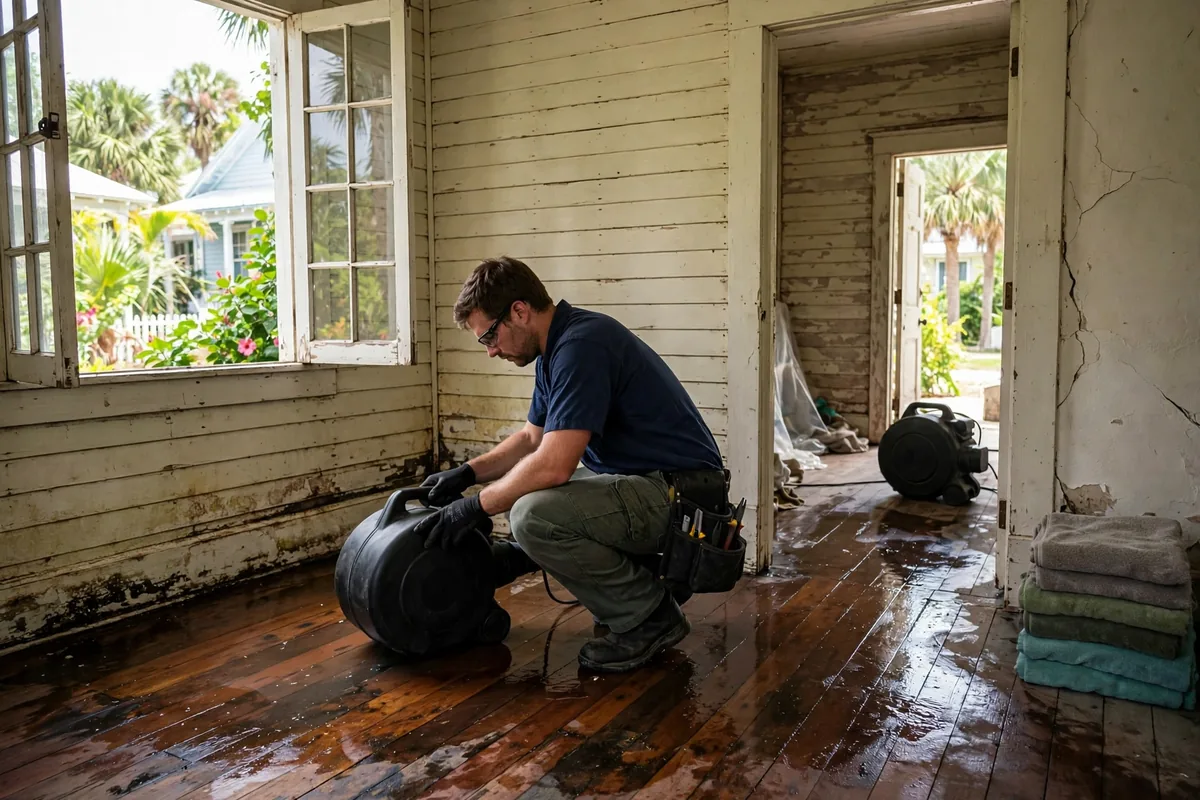
Drying starts with getting the liquid water out, then runs a planned dry-down; how aggressive each step is depends on the water's category and what it soaked. Extraction pulls standing water out first, then structural drying — drying the building's materials in place — takes over with an air mover, a high-speed fan, paired with an LGR dehumidifier that keeps pulling moisture from the air. Antimicrobial treatment — a cleaning application that slows mold and bacteria — finishes exposed surfaces.
Pros class every job by category. Category 1 water is clean, from a supply line. Category 2 carries soil or chemicals, like a dishwasher discharge. Category 3 is grossly contaminated — a sewage backup or lagoon flood water — and porous materials it touches usually come out. Materials decide the rest: a historic wood-frame cottage — the wood-built early-1900s homes this city is known for — often has wood floors worth careful drying, while drywall that stayed wet is usually cut at the flood line. Wet insulation holds moisture against framing, carpet pad acts like a sponge and is normally discarded, and in a slab-on-grade home water spreads under tile and grout, surfacing rooms away. Florida humidity defeats open-window drying, so sealed mechanical drying is what works.
What Should You Do In The First Hour — And What Should You Avoid?
First, stop the source if you safely can, then protect people, then protect the record. If a pipe or appliance is feeding it, close the main water shutoff — the valve where the main line enters the home, often near the meter — and let the pro handle the rest.
Keep everyone out of water that may have touched outlets or appliances, and never step into sewage or flood water with bare skin. A sagging, waterlogged ceiling can fall without warning — treat it as a closed room. What not to do yourself matters just as much: do not run a household vacuum on standing water — it is a shock hazard; do not aim household fans at contaminated water, which spreads contaminants; and do not tear out flooring or drywall in a rush, because removing materials that cannot be saved belongs in the pro's documented sequence, after photos and readings. While you wait, move dry belongings up high and photograph every wet room.
Which Neighborhoods And Housing Types Need The Most Watching?
The oldest, lowest housing carries the most risk here — the historic districts near downtown and the lagoon. College Park, the city's best-known neighborhood, is a historic district added to the National Register of Historic Places in 2001 and covering about 220 acres; its early cottages have aging plumbing runs and wood floors, so a slow leak travels quietly. Bryant Park and Parrot Cove sit by the lagoon shore, where tides and surge reach ground floors first; Mango Groves, Tropical Ridge, South Palm Park and ROLO hold more of the city's oldest small homes.
Renters are a huge share of this city: only 45.9% of homes are owner-occupied, the second-lowest share of the 19 Florida cities we serve, versus 67.6% statewide. If you rent, report a leak to your landlord in writing the day you find it and photograph your belongings. Condo owners: the HO-6 condo policy covering your unit's interior is separate from the association's master policy.
What Paperwork Makes An Insurance Claim Go Smoothly?
Claims are decided on documentation, so build the file from the first hour: dated photos and video of every wet area and the source if you can see it.
Ask the pro for the drying record — the moisture map, daily readings against the dry standard, and a written scope of work. Keep receipts, and keep removed materials until your adjuster says otherwise. If the water rose from outside rather than leaking from plumbing, flag that early — it is usually a flood-insurance question, with different rules than a homeowners claim.
Related Services We Offer
Water Getting Worse Right Now?
Standing water, a burst pipe or sewage cannot wait. See what to do first — and call now.
Neighborhoods We Serve In Lake Worth Beach
College Park
College Park Historic District was added to the National Register of Historic Places on February 9, 2001 and covers about 220 acres (Wikipedia, citing NRHP).
Bryant Park
A named neighborhood inside Lake Worth Beach, in ZIP 33460.
Commerce Park Village
A named neighborhood inside Lake Worth Beach, in ZIP 33460.
Downtown Jewel
A named neighborhood inside Lake Worth Beach, in ZIP 33460.
Eden Place
A named neighborhood inside Lake Worth Beach, in ZIP 33460.
Lake Cove
A named neighborhood inside Lake Worth Beach, in ZIP 33460.
Mango Groves
A named neighborhood inside Lake Worth Beach, in ZIP 33460.
Memorial Park
A named neighborhood inside Lake Worth Beach, in ZIP 33460.
Neighborhoods we serve include:
- Bryant Park
- College Park
- Commerce Park Village
- Downtown Jewel
- Eden Place
- Lake Cove
- Mango Groves
- Memorial Park
- Murray Hills
- Northeast Lucerne
- Old Lucerne
- Old Town
- Parrot Cove
- Pineapple Beach
- ROLO
- Royal Poinciana
- South Palm Park
- Southeast Lucerne
- Sunset Ridge
- Tropical Ridge
- Vernon Heights
- Whispering Palms
Show All 22 Neighborhoods
- Bryant Park
- College Park
- Commerce Park Village
- Downtown Jewel
- Eden Place
- Lake Cove
- Mango Groves
- Memorial Park
- Murray Hills
- Northeast Lucerne
- Old Lucerne
- Old Town
- Parrot Cove
- Pineapple Beach
- ROLO
- Royal Poinciana
- South Palm Park
- Southeast Lucerne
- Sunset Ridge
- Tropical Ridge
- Vernon Heights
- Whispering Palms
What Happens When You Call
1. You Call — It’s Free
One free call, answered 24/7. Tell us where the water is and what happened. There is no charge for the call and no obligation to book anything.
2. We Connect You With An Independent Local Pro
We match your call with an independent local water damage professional who serves your area — a separate local business, not our own crew.
3. The Pro Calls You Back Or Visits To Check The Problem
The pro can typically arrive in 30–60 minutes to check the problem in person, measure the moisture and explain the next steps before any work begins.
Why Lake Worth Beach Calls Start With One Free Call
This site is a referral service, not a restoration company: the call costs nothing, and it connects you with an independent local water damage pro who does the inspection and the work. The pro is their own business, with their own pricing.
In a city where the typical house predates 1970, speed matters. Explain the problem once, and the responding pro can typically arrive in 30–60 minutes, day or night. Scope, cost and timing are agreed with that pro, in writing, before work begins.
What Homeowners Say
Reviews shown exactly as given to us (name, city, words) — we do not edit them.
“Dishwasher supply line snapped and flooded our newly renovated kitchen. The technicians were meticulous about drying behind the custom cabinetry without having to tear it all out. Impressive work.”
Linda H. · West Palm Beach, FL
“Water entered through an exterior stucco crack during a tropical depression. They pinpointed the exact entry point with infrared sensors and dried the interior walls thoroughly.”
Raymond K. · Boynton Beach, FL
“Quick response and very professional drying team. Took off one star simply because dealing with insurance paperwork is never painless, though the office team did their best to assist.”
Eric Y. · Delray Beach, FL
ZIP Codes We Serve In Lake Worth Beach
Lake Worth Beach ZIP codes we serve: 33449, 33460, 33461, 33462, 33463, 33467. If your ZIP is not listed, call and we will confirm coverage.
Lake Worth Beach Water Damage Questions
Which ZIP Codes Does Lake Worth Beach Actually Use?
The city's own ZIP codes are 33460, 33461, 33463 and 33467, and one free call covers all of them. ZIP 33460 holds most of the historic neighborhoods, including College Park and Bryant Park. Your flood zone and how low your street sits near the lagoon matter more than the ZIP.
Why Do The Historic Cottages In College Park Leak So Often?
Many College Park homes are a century old, with early plumbing: cast iron drains that corrode from inside, galvanized supply lines narrowed by rust, and wood framing that hides slow leaks. Pinhole leaks and drain failures are a steady pattern here, not bad luck.
Can Lagoon Water Really Get Into My Home Without A Hurricane?
Yes. A king tide can push lagoon water over low seawalls and up through storm drains, wetting ground floors on the lowest streets near the shore. That water is brackish and dirty, so treat it as contaminated — keep people and pets out of it and have a pro check what it touched.
I Rent In Lake Worth Beach. Who Handles A Leak — Me Or My Landlord?
Drying and repairs are the property owner's job; yours is to report the leak fast, in writing, and protect your belongings. With only 45.9% of city homes owner-occupied, this comes up constantly here. Photograph damaged items and keep receipts — the building's insurance does not cover your property.
How Much Rain Does Lake Worth Beach Actually Get?
About 61.75 inches a year on average, from NOAA's 1991–2020 climate normals at the West Palm Beach Intl AP station — 3rd highest of the 19 Florida cities we serve. Much of it lands in summer cloudbursts, so roof leaks and street flooding often appear on the same afternoon.
Does A Standard Homeowners Policy Cover Flooding From The Lagoon Or The Ocean?
No. Standard homeowners insurance excludes rising water from outside the home, from the lagoon, the ocean or the street. Flood coverage is a separate policy, usually through the NFIP, and normally takes 30 days to take effect — buy it before storm season, not during it.
Related Guides
Renters And Water Damage: Who Pays For What
Guide — does renters insurance cover water damage
Condo Leak? Who Is Responsible — You, The HOA, Or The Unit Above
Guide — does condo insurance cover water damage
Flood Insurance In Florida: Why Homeowners Insurance Is Not Enough
Guide — flood insurance florida homeowners
Reviewed By Hamza
Role: CEO
Hamza is the CEO of this business. He is very expert in local business and has great experience.
Updated October 23, 2026
Sources
Water In Your Home Right Now?
One free call connects you with an independent local pro who can typically arrive in 30–60 minutes.
📞 Call Now — It’s FreeFree Call · Answered 24/7 · Local Pros Near You